Best Self-Hosted Inference Servers for Open-Source Models: 7 Options Compared in 2026
From Ollama and LocalAI to vLLM and SIE, this guide matches each server to the workloads, model fleets, and production trade-offs it handles best.
The great decision to self-host has landed. The model weights are available, your data stays under your control, and there is no per-token bill waiting for the accounting department.
Then you open a list of inference servers and find more than a dozen options. Every project promises speed. Very few help you decide which kind of speed you actually need.
The most useful question is not simply, “Which server has the highest throughput?” It is this: do you need to serve one main model or a fleet of models?
Single-model servers squeeze as much performance as possible from one primary model per worker. Multi-model servers are designed to run and route across a broader model fleet. That distinction matters because most AI agents do much more than generate text.
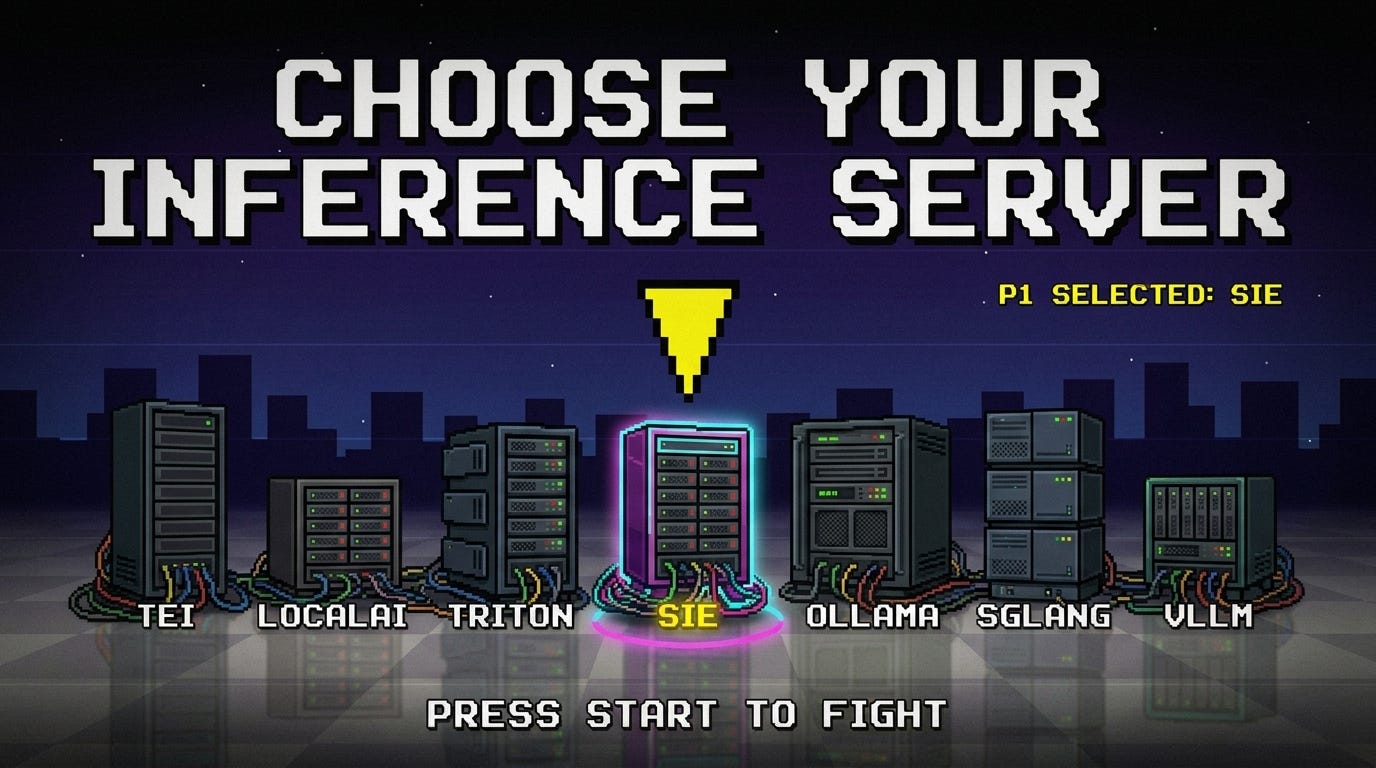
In this article, we picked and compared seven self-hosted inference servers for open models: Hugging Face TEI, LocalAI, NVIDIA Dynamo-Triton, Ollama, SGLang, SIE, and vLLM.
The goal is to match each server to the workload it handles best.
Why Self-Host Open Models?
Self-hosting is work, so it is worth checking why you want it before choosing the machinery.
The usual reasons are:
Quality: Open models are good enough for a growing number of production tasks. Research discussed by MIT Sloan found that open models reached roughly 90 percent of closed-model performance at launch.
Cost: Self-hosting changes the cost curve. Instead of paying for every token, you pay for hardware, idle capacity, engineering time, and operations.
Data control: When prompts, documents, or outputs cannot leave your environment, self-hosting may be the simplest way to meet privacy and residency requirements.
These benefits come with a trade-off. Self-hosting moves work from an API bill to your infrastructure and engineering teams. A good inference server earns its place by shrinking that operational burden while using your hardware efficiently.
One pricing note applies to every option in this guide: free software does not mean free inference. You still pay for the machines, storage, networking, monitoring, and the people keeping everything alive.
Single-Model vs. Multi-Model Servers
A single-model server usually centers each worker or deployment on one primary model. It can then optimize batching, memory paging, attention kernels, and request scheduling around that model.
If you need three unrelated models, you will often run three workers or deployments.
A multi-model server is built to host or coordinate several models and route each request to the right one. Depending on the server, those models may remain loaded together, load on demand, or share a GPU pool.
Why does this distinction decide the article? Because an agent is rarely just one model.
A typical request might:
Embed a query.
Retrieve documents.
Rerank the candidates.
Extract structured fields.
Run a safety check.
Generate the final answer.
That workflow may involve five models, most of them small. Run each one as a separate single-model service, and you now have five deployments, each with its own container, scaling policy, and monitoring. Run the small-model fleet on a multi-model server, and you have far less infrastructure to operate.
Rule of thumb: One heavy generative model? Single-model server. A fleet of smaller task models? Multi-model server. Both at once (common)? You will run one of each, and that is fine.
Inference Servers at a Glance
The servers below are listed alphabetically, not ranked.

TEI focuses on embeddings and reranking, while LocalAI supports multiple model types on modest hardware. Dynamo-Triton targets heterogeneous enterprise workloads but has a large configuration surface.
Ollama is best for local development and offline use, while SGLang and vLLM focus on high-performance serving for a primary model. SIE is designed for an agent’s fleet of task-specific models, complementing rather than replacing large-LLM servers.
All options are free to self-host, except for infrastructure costs and optional managed services.
Hugging Face TEI (Text Embeddings Inference)
Text Embeddings Inference is Hugging Face’s Rust-based server for embedding, reranking, and sequence-classification models. It is a specialist, and that is its appeal.
TEI offers dynamic batching, token-based batching, optimized inference, OpenAI-compatible embeddings, and a native reranking endpoint. It runs on CPUs and several accelerator families. For a private embedding model or cross-encoder reranker in a retrieval pipeline, it is a clean production choice.
The catch is the deployment shape. A TEI instance serves one model, so an embedder and a reranker normally mean two instances. That is easy to understand and tune, but the operational count climbs as the model fleet grows.
Pricing: TEI is free under Apache 2.0. You pay for your own compute. If you prefer a managed deployment, Hugging Face Inference Endpoints supports TEI and charges by the minute at an hourly instance rate; current entry prices start around $0.032 per CPU core-hour and $0.50 per GPU-hour.
Best for: Focused, self-hosted embedding and reranking workloads with one or two pinned models.
LocalAI
LocalAI is an OpenAI-compatible API that runs on your own hardware. Its selling point is breadth.
It supports many backends and model types, including language, vision, image generation, speech, and embeddings. It can run on commodity CPUs as well as GPUs, and the project ships container images for a relatively quick start.
That flexibility creates more configuration choices. Backend selection, model formats, memory settings, and hardware-specific tuning can all affect performance. LocalAI is a versatile generalist, but it does not remove the need to benchmark your exact models on your exact machine.
Pricing: LocalAI is free under the MIT license. There is no required platform subscription; your costs are the hardware, storage, and operations you bring to it.
Best for: Teams that want one OpenAI-compatible interface for several model types on local or modest hardware.
NVIDIA Dynamo-Triton
NVIDIA Dynamo-Triton, formerly Triton Inference Server, is an enterprise-grade server for running models from different frameworks behind HTTP or gRPC APIs.
One deployment can serve TensorRT, PyTorch, ONNX, OpenVINO, Python, and RAPIDS FIL models side by side. It supports dynamic batching, concurrent execution, streaming workloads, and model ensembles. Although it is most closely associated with NVIDIA GPUs, the current product also supports CPUs and some non-NVIDIA accelerators.
It is genuinely powerful and genuinely heavy. The model repository, backend choices, deployment settings, and surrounding Kubernetes or monitoring setup create a large configuration surface. This is usually a platform-team tool. In the right hands, it can consolidate a heterogeneous production estate.
Pricing: The open-source server is free to use, and you supply the infrastructure. Commercial support and production packaging are available through NVIDIA AI Enterprise, with pricing provided through NVIDIA or its partners.
Best for: Teams serving heterogeneous models across frameworks at scale, especially in an NVIDIA-centered environment.
Ollama
Ollama bundles model management, inference, and an HTTP API into a straightforward local experience. Pull a model, run it, and you have a private endpoint without first assembling a serving stack.
Ollama detects common acceleration options, including CUDA, ROCm, and Apple Metal, and can keep multiple models locally while loading and unloading them as needed. For getting a private model running on a laptop in a few minutes, it remains one of the easiest choices.
Its sweet spot is local and small-team use. You can tune parallelism and keep models warm, but Ollama is not primarily designed as a high-concurrency, multi-node production serving platform.
Pricing: Running Ollama on your own hardware is free. Ollama Cloud has a free plan, while Pro costs $20 per month or $200 per year. Cloud usage limits and available plans can change, so check the pricing page before committing.
Best for: Local development, prototyping, offline assistants, and single-user workflows.
SGLang
SGLang is a high-performance serving framework tuned for large language and multimodal models. Its RadixAttention system reuses shared prefixes, which can pay off in workloads with repeated system prompts, long conversations, RAG, or agent loops.
SGLang also puts serious attention into structured generation, speculative decoding, parallelism, and model routing. That makes it especially interesting when your application repeatedly calls the same large model with overlapping context.
The trade-off is focus. SGLang is built around high-performance generative serving, not around squeezing a mixed collection of embedders, rerankers, classifiers, and extractors into one small-model pool.
Pricing: SGLang is free under Apache 2.0, with no required paid tier. You pay for the infrastructure and production tooling around it. Managed services such as Hugging Face Inference Endpoints can also deploy SGLang at their own compute rates.
Best for: A large generative model in an agent, RAG, or structured-output pipeline, especially when prefix reuse matters.
SIE (Superlinked Inference Engine)
SIE approaches inference from the other direction. Where many engines spread one large model across several GPUs, SIE is designed to run a fleet of smaller task-specific models across shared resources.
Its catalog covers more than 100 models and tasks, including embeddings, reranking, extraction, content safety, OCR, image understanding, and smaller-scale generation. Models can load on demand and leave memory when capacity is needed elsewhere.
The open-source project includes more than the inference process. It also ships a load-balancing gateway, KEDA autoscaling, Grafana dashboards, Helm packaging, and Terraform modules for major cloud platforms. That makes it a production stack rather than only a local server.
SIE is not intended to serve one giant frontier-sized language model. Its value is consolidating the smaller models surrounding that model.
Best for: An agent’s fleet of task-specific models when you also want the deployment and autoscaling stack included.
vLLM
vLLM is the throughput workhorse of open-source LLM serving. PagedAttention, continuous batching, prefix caching, quantization support, and a broad model ecosystem make it a common starting point for production language-model inference.
It also has a large community and support across NVIDIA CUDA, AMD ROCm, CPUs, and other accelerator backends. If you need to serve one main generative model at high concurrency, vLLM is the safest default in this group.
Its center of gravity is still the large generative model. It supports features such as LoRA adapters and distributed serving, but a mixed fleet of embedders, rerankers, safety models, and extractors usually means additional workers or services.
Pricing: vLLM is free under Apache 2.0, with no required paid tier. Your bill comes from the GPUs or other compute running it, plus the orchestration and monitoring around those workers.
Best for: One large generative model at high throughput across a broad range of hardware.
How to Choose
The shortlist gets easier once you stop asking which server is “best” and ask what your workload actually looks like.
Then ask the harder question: what will it take to run this in production?
“It runs on my machine” is not the same as “it scales, exposes useful metrics, survives a traffic spike, and does not need a dedicated engineer to babysit it.” The raw server matters. So do model loading, routing, autoscaling, observability, upgrades, and failure recovery.
Heading to Production
The inference-server market roughly splits into two camps: servers that maximize the performance of one primary model and servers that coordinate a fleet.
If your workload is one large generative model, begin with vLLM or SGLang. If it is a focused retrieval service, TEI may be all you need. If you are building locally, Ollama or LocalAI will get you moving quickly. For a heterogeneous enterprise model estate, Dynamo-Triton has the broadest platform story.
If the shape of your problem is an agent’s fleet of small models, and the part you do not want to build is the production wiring around them, SIE deserves a close look. You can self-host it under Apache 2.0 or use the managed version.
See how to put together the LEGOs at Superlinked docs. Try it against your own eval, on your own hardware.
For many production agents, the answer will be a pair: vLLM or SGLang for the large generative model, plus SIE or dedicated TEI workers for the smaller task models around it. That architecture covers both halves of the workload without asking one server to be good at everything.
Benchmark the combination against your own evaluations, traffic shape, latency targets, and hardware. Inference servers are opinionated pieces of infrastructure. The right one is the one whose opinions match your system.
Frequently Asked Questions
What is the difference between a single-model and a multi-model inference server?
A single-model server usually dedicates each worker to one primary model and optimizes around it. A multi-model server is designed to host or coordinate several models and route requests among them. The boundary is not absolute, but it is a useful way to predict how much infrastructure a model fleet will require.
Which inference server is best for an AI agent?
It depends on the agent. If the agent relies mainly on one large language model, start with vLLM or SGLang. If it uses a fleet for embedding, reranking, extraction, safety, OCR, and other tasks, use a multi-model server such as SIE or combine specialized TEI workers with your own orchestration.
Is Ollama suitable for production?
Ollama is excellent for local development, prototypes, offline tools, and smaller internal deployments. You can tune it beyond the defaults, but high-concurrency or multi-node serving is not its main design center. Test it under your real load before making it the production layer for a public application.
Do I still need vLLM or SGLang if I use SIE?
Often, yes. They solve different parts of the stack. SIE is designed for the smaller task models an agent uses, while vLLM and SGLang specialize in serving large generative models at high throughput. Running both is often simpler than forcing either one to handle the entire workload.
Hi there! Thanks for making it to the end of this post! If you enjoyed this content and would like to support my work, consider becoming a paid subscriber. Your support means a lot!


