

AI models can now pass medical licensing exams, write complex code, and solve Millennium Prize problems. And yet when you walk into a clinic, the doctor is still typing notes into the same slow hospital system and flipping through PDFs of your old lab results.
Most of the healthcare industry has not adopted these models for real, daily work.
Why is that? I think there are two reasons for that.
The first is cost. Frontier models are expensive to run, and a hospital that sends every patient question, scan, and lab report through a paid API will see that bill grow very fast.
The second is that these models are generalists. They were trained to be good at everything, which is different from being trained and tested specifically on clinical work.
This week, Ant Group released something that goes after both problems.
The company unveiled a family of AI models built specifically for healthcare, called LingSante, and said it plans to gradually make them open source. Two of them are already available to download.
LingSante-3.1-air-VL is a multimodal model that processes text and images.
LingSante-3.1-flash is a larger text model designed for medical reasoning, evidence review, and multi-step healthcare tasks.
LingSante is a family of medical and health AI models built on top of Ant Ling, which is Ant Group’s own foundation model series.
The release was actually part of an announcement from Afu, Ant Group’s AI health app that currently has 150 million users. They were receiving 20 million health questions a day, and it needed models that could answer them well without costing a fortune.
LingSante-3.1-air-VL: A small model that reads medical images
LingSante-3.1-air-VL is the lightweight one, built for reading medical images, skin photos, meals, and lab reports.
Here are the basic specs:
124 billion total parameters
5.5 billion active parameters per token
256K-token context window
Text and image input
MIT license
The two parameter numbers can look confusing, so let me explain them, because they matter for the rest of this article.
LingSante uses a Mixture-of-Experts (MoE) design. Instead of pushing every word through the entire network, the model is split into many smaller “expert” blocks, and a router picks only a few of them for each token.
The full model has 124 billion parameters sitting in memory, but only about 5.5 billion of them do any work on a given token.
That’s roughly 4% of the model. The total parameter count tells you how much memory you need to load the model, and the active parameter count tells you how much computing it takes to generate each word.
A low active count means faster responses and a lower cost per answer.
This is how Ant can describe a 124-billion-parameter model as lightweight. Ant’s blog says air-VL has been adapted to run locally on Nvidia’s DGX Spark and RTX Spark hardware.
If you wish to try it on your local machine, you can download the weights on Hugging Face with over 250 GB of data.
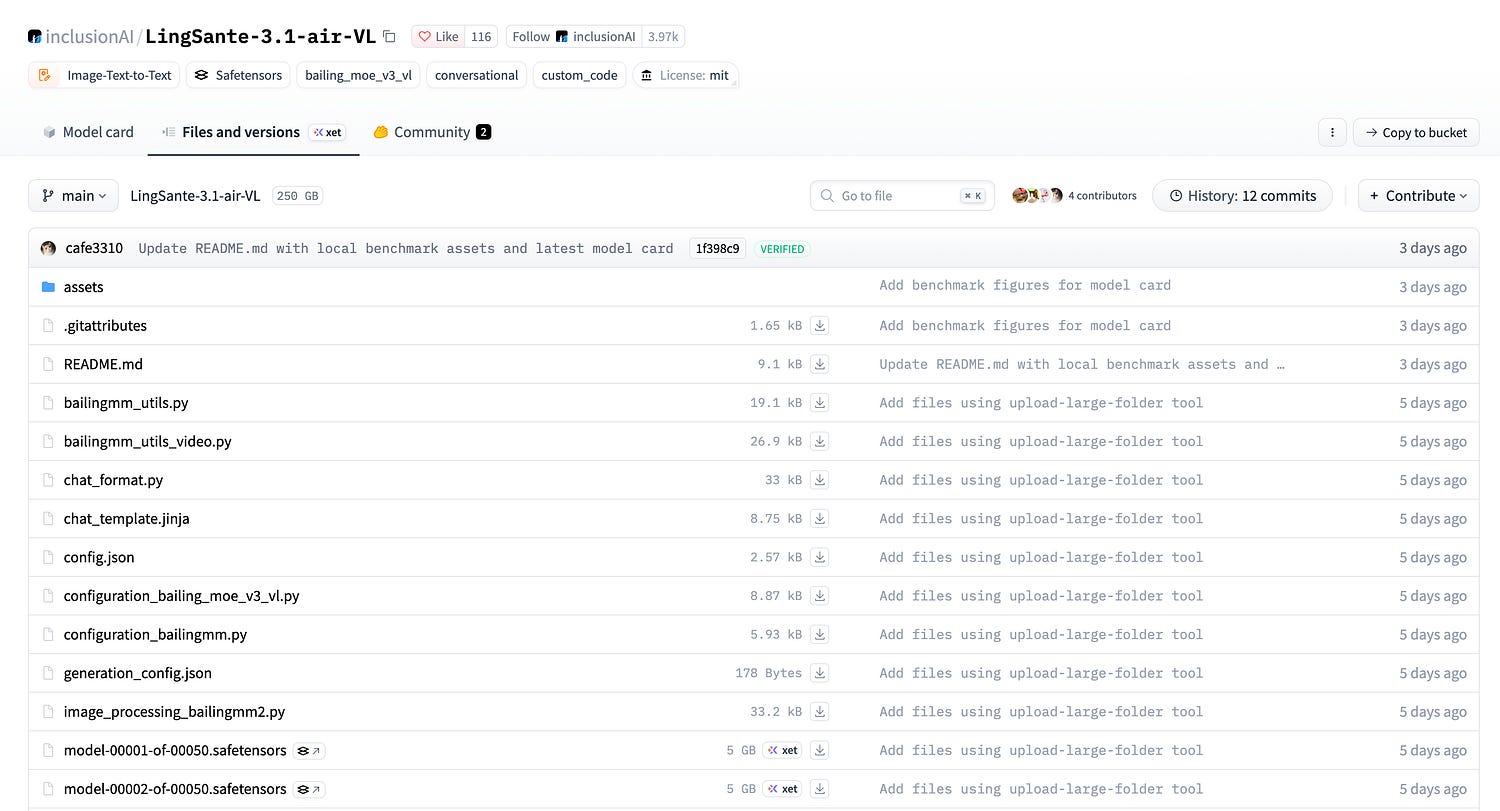
According to Ant, Microsoft is also demoing it running locally on a Surface Laptop Ultra to support doctor-patient consultations.
The recommended server setup on the model card still lists four 141GB-class GPUs to run it at full precision. Running it on a smaller machine means using the quantized version Ant published alongside it, which compresses the weights so they fit in less memory.
Still, a medical model that runs on a machine sitting inside the clinic is a big deal for one simple reason. Patient data doesn’t have to leave the building.
Let’s look at some demos
Ant posted a thread of demos and benchmarks on X. Here are some of the most interesting:
From chest X-ray to report: The model takes a chest X-ray and writes a structured report with a Findings section and an Impression section. That’s the same format a radiologist uses.


The model follows an ABCDE review, which is the standard checklist for reading a chest film, and then works through a differential diagnosis.
On a complicated X-ray it can pick up eight to nine categories of abnormal findings in a single pass, including an enlarged heart outline, pleural effusion, collapsed lung tissue, consolidation, and signs that suggest pneumonia.
Ant is clear that this feature is for research use only and is not a substitute for a physician’s diagnosis. I think that’s the correct way to frame it. A radiologist doesn’t need an AI to make the call.
2. Multimodal health analysis: This demo is the one most regular people will care about, because it covers the everyday questions.

You can send a photo of a skin problem along with a description of your symptoms. The model covers more than 120 skin conditions, and it asks follow-up questions before answering.
Where on the body is it? How long has it been there? Does it itch or hurt?
I find that detail more important than the 120 number. A photo of a red patch could be ten different things, and a good dermatologist always asks questions first.
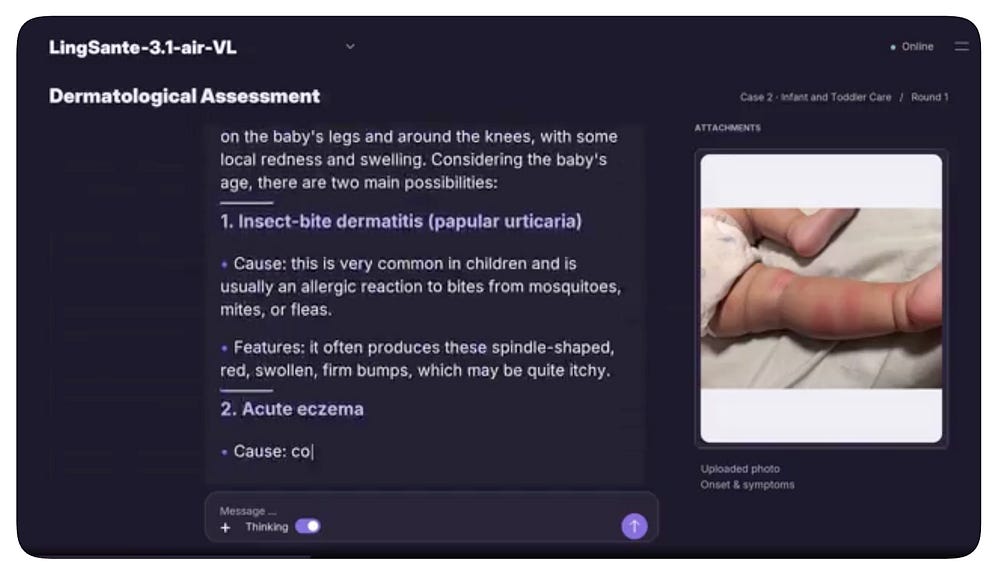
A model that jumps straight to an answer from a single photo is the kind that sends people into a panic at midnight.
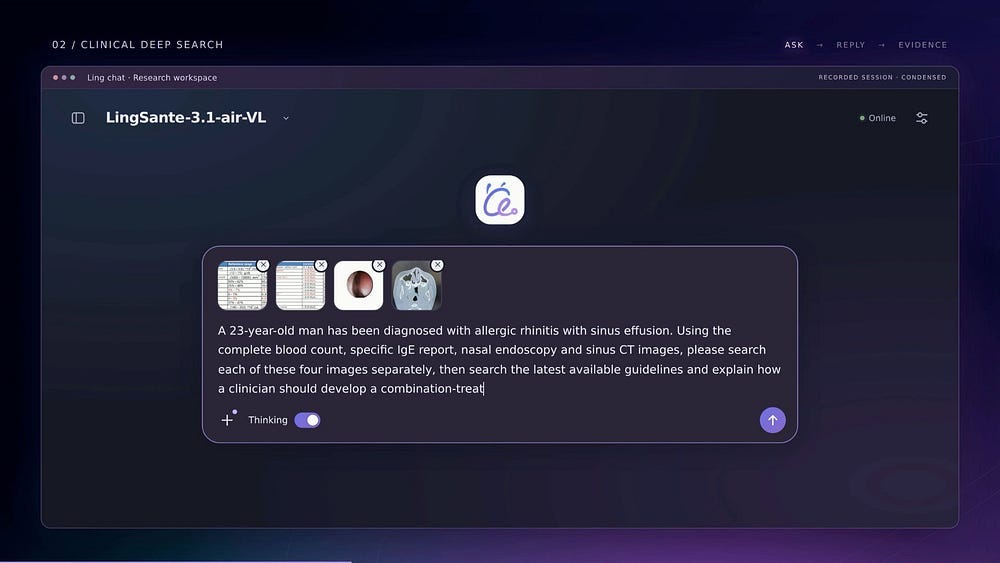
The same model can look at a photo of a meal, identify the ingredients (even ones that are partly hidden), and estimate the portions. It can also read a lab report, such as a complete blood count or inflammatory markers, and suggest what to do next.
3. From images to evidence: This demo is my favorite, because it deals with a problem that general chatbots handle badly.

Two skin photos can look almost identical and mean completely different things medically. So the model doesn’t just rely on what it memorized during training.
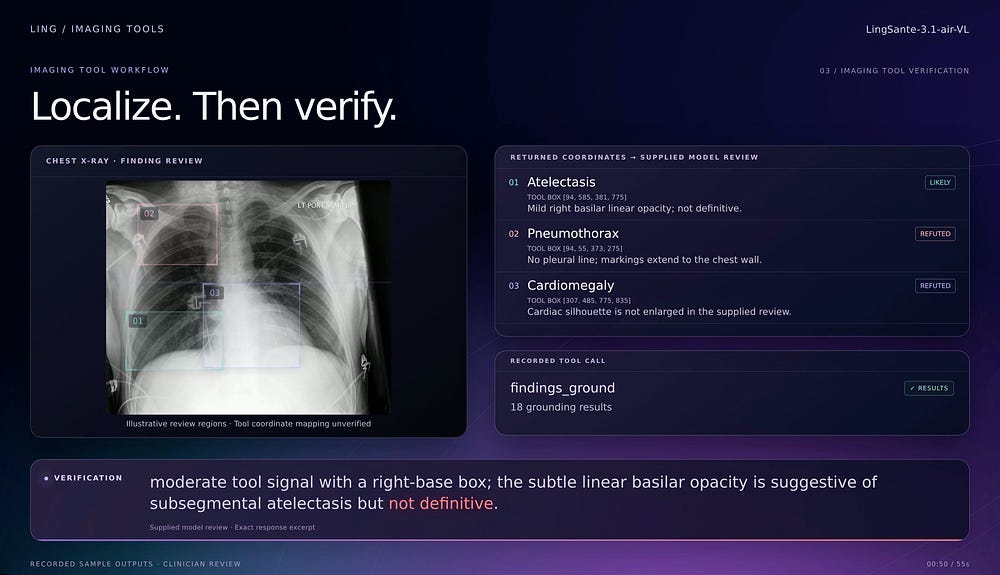
It runs an image-based search to find similar cases and related medical literature, then checks that evidence before it gives its analysis.
In other words, it looks things up and shows where the answer came from. An answer you can trace back to a real case or a published paper is one a doctor can verify.
LingSante-3.1-flash: The bigger model built for complex cases
If air-VL is the model that looks at things, LingSante-3.1-flash is the one that thinks through them. It’s a text-only model aimed at professional use, and it’s a lot bigger.
560 billion total parameters
About 25 billion active parameters per token
1 million-token context window
Text input only
MIT license
It uses the same MoE idea as air-VL. The model card says each layer has 512 routed experts and only 8 of them are activated per token, which is how a 560-billion-parameter model ends up using only about 25 billion on each word.
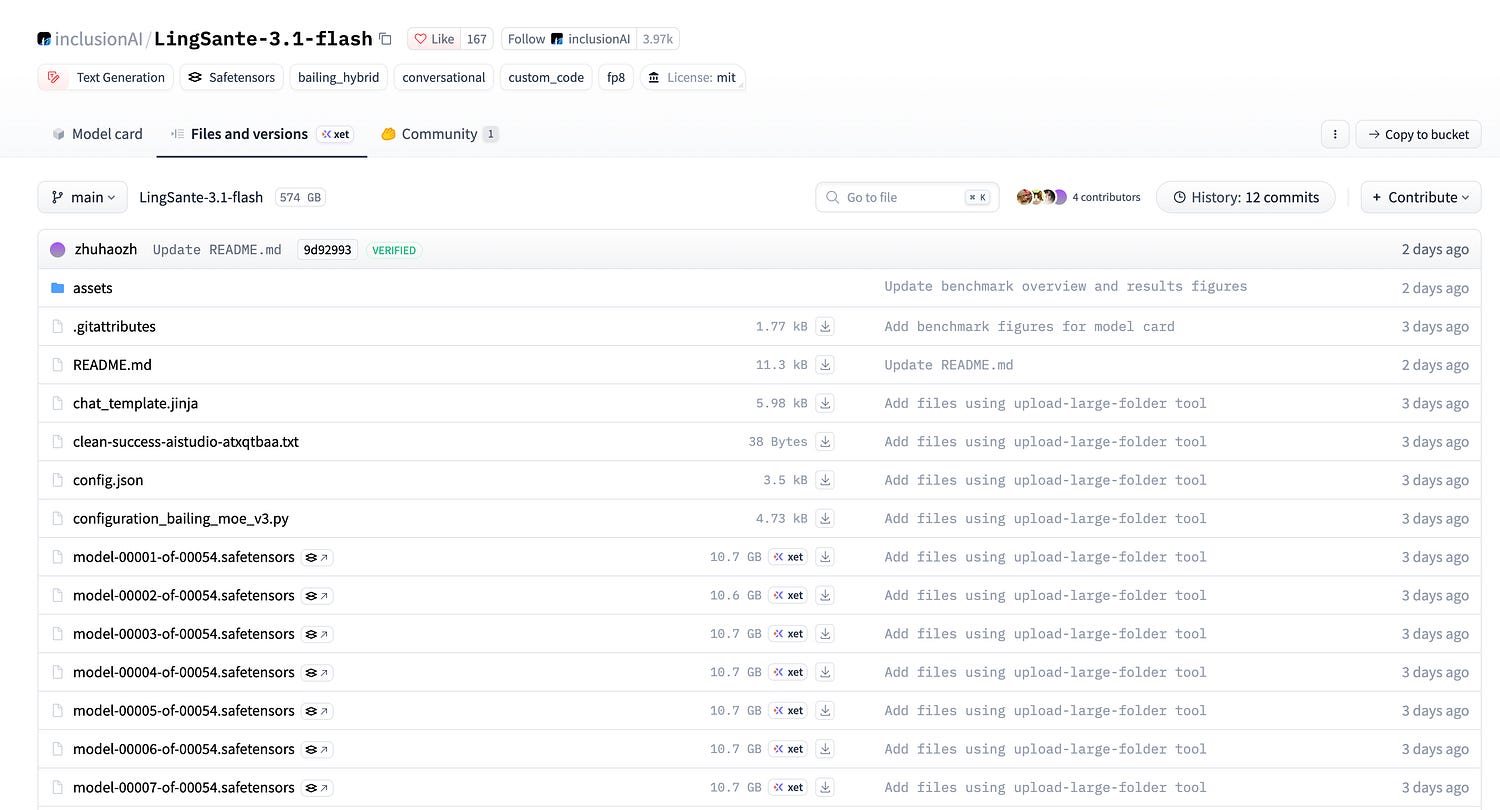
On Hugging Face, the model weights download files size is around 580 GB.
Let’s talk about that 1 million-token context window.
Think about what a real patient record looks like. Someone with diabetes and a heart condition might have five or ten years of consultation notes, lab results, prescriptions, discharge summaries, and imaging reports spread across different departments. That is far too much text for most models to read in one go, so the usual workaround is to chop it into pieces and search for the relevant parts.
The trouble is that the important detail in medicine is often the one nobody thought to search for. A drug prescribed by one specialist three years ago that interacts badly with something another specialist prescribed last month is a good example. A model that can hold the entire history at once has a better chance of catching that.
I should add that Ant’s own model card warns that a long context doesn’t guarantee the model will retrieve everything in it. I’m glad they wrote that down, because it’s true of every long-context model and most companies don’t mention it.
Ant’s technical blog for flash focuses on three areas, which are medical knowledge, evidence-based retrieval, and long multi-step workflows. The demos give a better idea of what that means in real work.
In one of them, the model compares the treatment guidelines from the ADA, KDIGO, and Chinese medical bodies for a patient with type 2 diabetes, chronic kidney disease, and heart failure. Anyone who has tried to line up three guidelines for a patient with three overlapping conditions knows how long that takes by hand.
How do they compare with GPT-6 Astra and Gemini 4 Argon?
According to Ant’s benchmark results, LingSante-3.1-flash beats both GPT-6 Astra and Gemini 4 Argon on HLE, BrowseComp, HealthBench, and EHR-Complex.
Here’s the summary of the results:
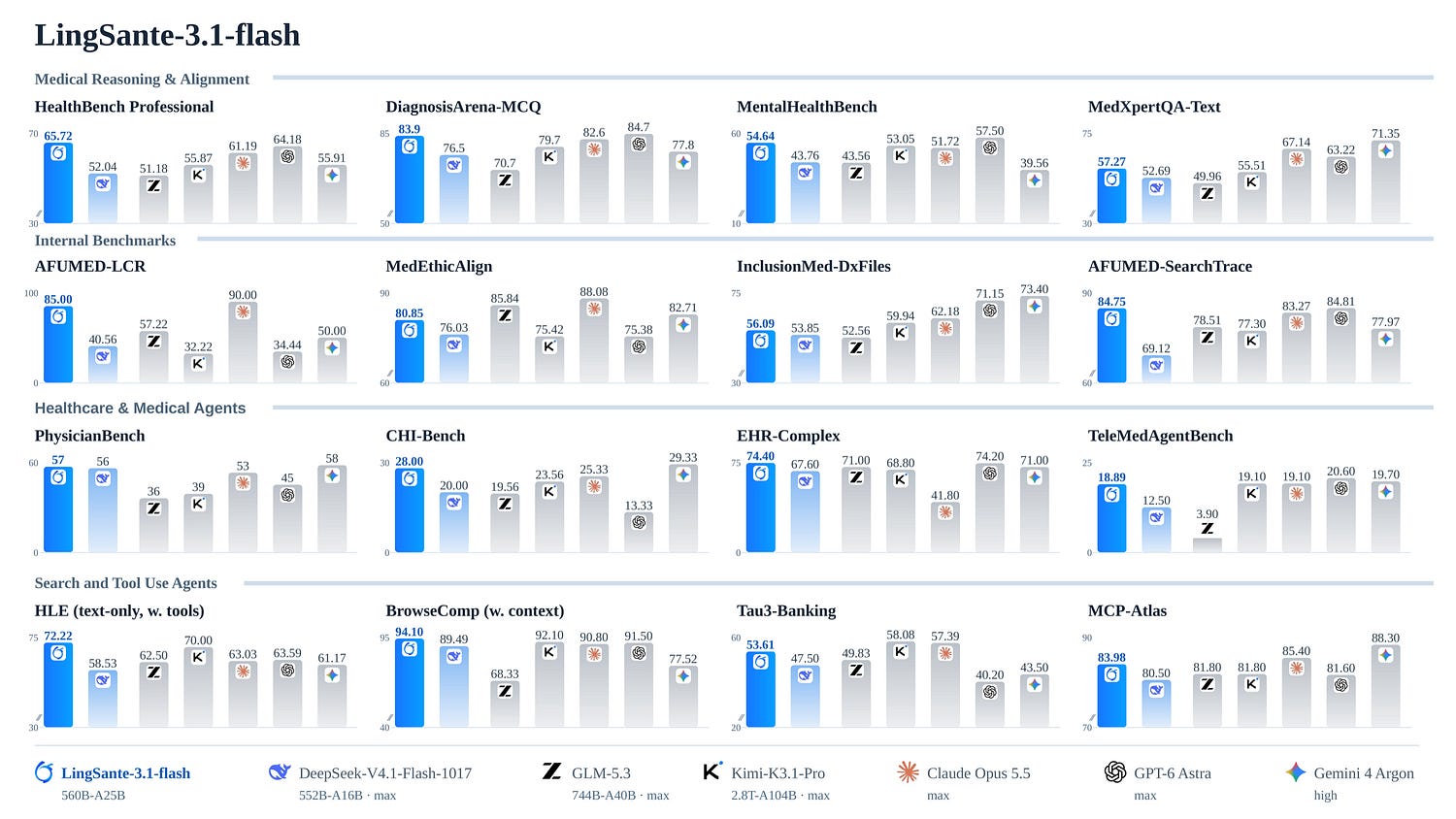
Those four tests have something in common. They all require the model to find information and combine it across several steps, like searching for evidence, reading through a health record, and putting together an answer from multiple sources. That’s exactly the kind of work the model was trained for.
It loses on three others.
MedXpertQA, which tests recall of textbook medical knowledge
MedEthicAlign, which tests ethics and alignment judgment
InclusionMed-DxFiles, a diagnostic benchmark where a differently tuned model does better
I think this pattern makes sense, and it’s the reason I believe the wins.
Flash activates about 25 billion parameters per token, which is much smaller than the frontier models it’s compared against. A smaller model stores less raw knowledge, so it loses when the test is about recalling facts and wins when the test is about looking things up and reasoning over what it found.
If Ant had claimed flash beats GPT-6 at everything, I wouldn’t trust any of it.
Air-VL beats models several times its size on medical images
For air-VL, the advantage is clinical visual understanding. Ant’s results show it coming out ahead on five out of five visual tasks.
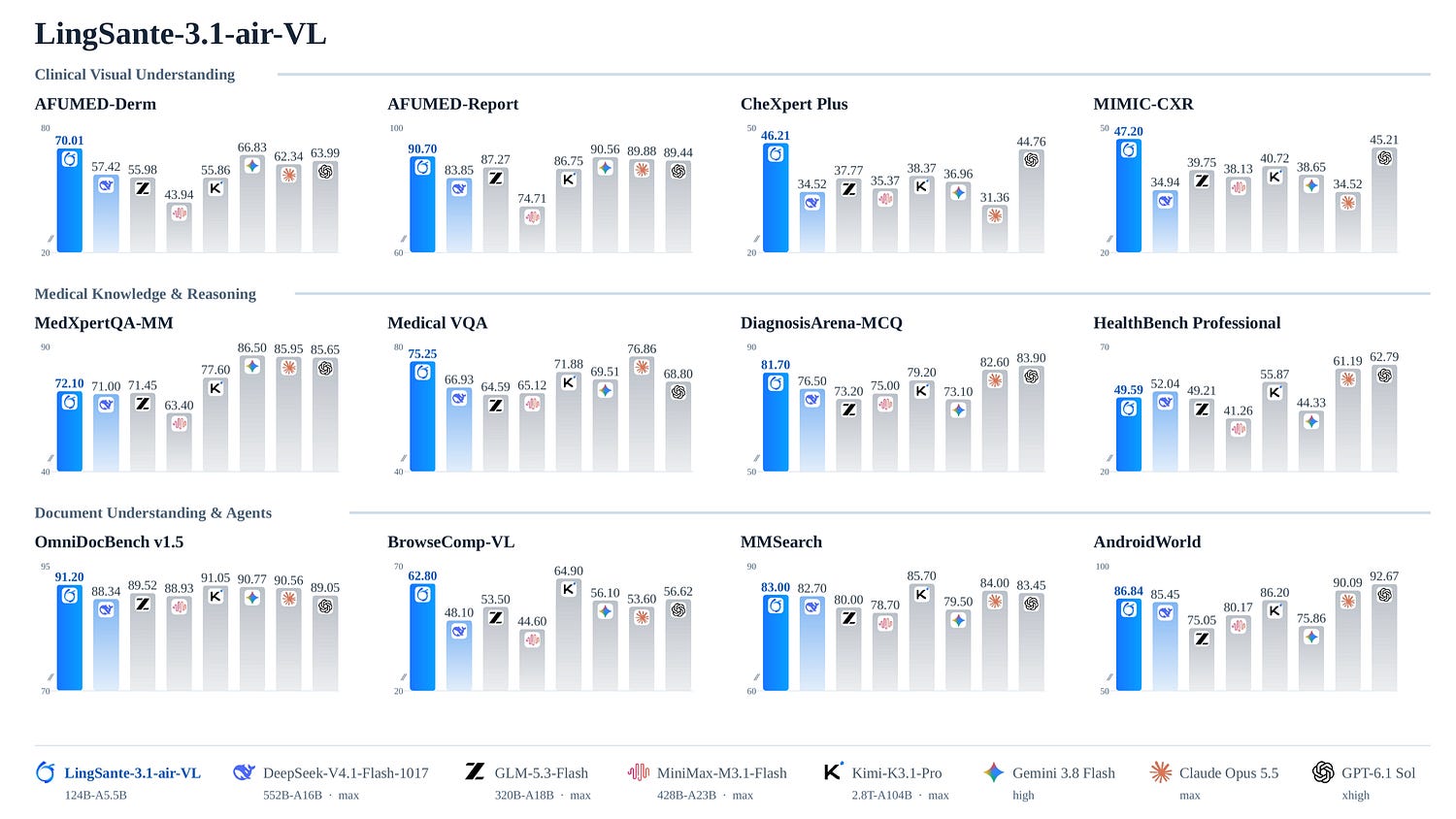
The head-to-head records against other open models are what stood out to me. Air-VL activates 5.5 billion parameters per token.
Against the GLM and MiniMax models in the comparison, which activate 18 billion and 23 billion, it won all 12 of the shared benchmarks against each. Against Kimi-K3.1-Pro, which activates 104 billion, it won 8 and lost 4.
That last result is the most impressive one to me. Kimi uses about 19 times more active parameters per token, and air-VL still has the winning record.
Air-VL does have clear weak spots. It falls behind on medical knowledge tests and agentic tasks, and Ant admits in its own blog that the model “still lags behind leading closed-source flagship models” on complex multimodal medical reasoning and long multi-step workflows.
That’s fine, because those are flash’s strengths. The two models are meant to work together. Air-VL reads the image, and flash does the reasoning over the result.
A hospital could run air-VL locally on the machine next to the X-ray room and send the harder cases to flash on a server.
Flash ranked first among open-source models on InclusionMed
Alongside the models, Ant launched InclusionMed, an open evaluation platform for medical AI built with researchers from 29 institutions, including Stanford University, Harvard University, and Peking Union Medical College.
In the first rankings, LingSante-3.1-flash was the top open-source model.
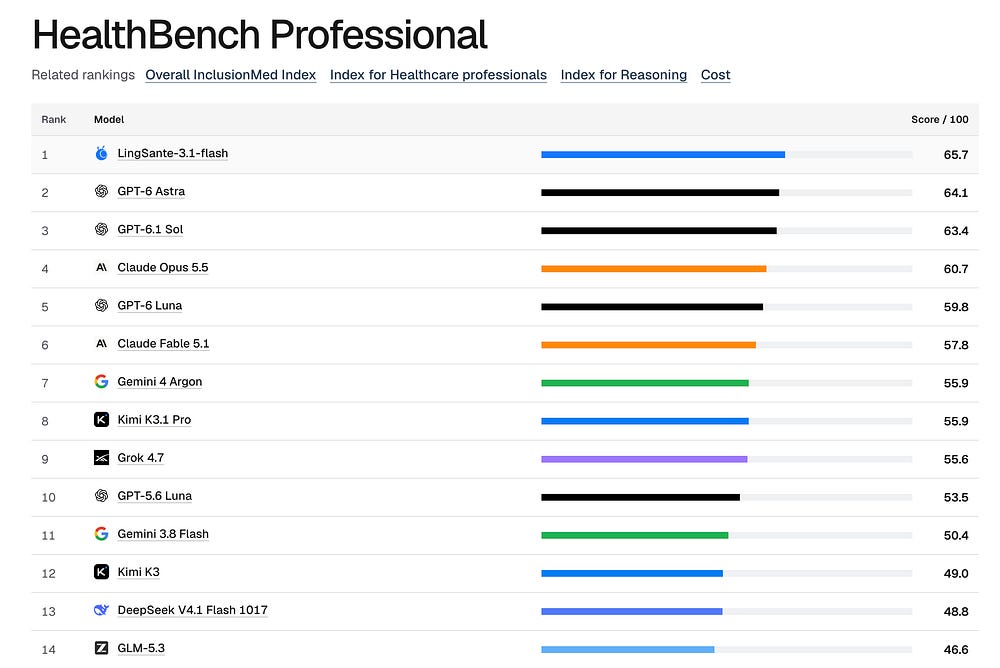
An open-weight model with 25 billion active parameters is sitting on top of OpenAI’s flagship on a medical leaderboard. A year ago I would not have expected that from a model anyone can download for free.
Take note that LingSante-3.1-flash leads CHI-Bench with 26.2, which covers healthcare operations work.
This is the result that supports the whole argument for domain-enhanced models. Flash gets a score in the same range as the biggest general-purpose models, and it does it for a fraction of what they cost to run.
How to try LingSante
LingSante-3.1-air-VL is available in two ways. You can download the open weights and run it yourself, or you can use it through an API.
If you want to run the model in your own environment, the weights and the model card are on both Hugging Face and ModelScope.
LingSante-3.1-air-VL on Hugging Face and ModelScope
LingSante-3.1-air-VL-MXFP4 on Hugging Face and ModelScope
The MXFP4 version is the quantized one I mentioned earlier. It’s the one to pick if you’re running on smaller hardware, because the compressed weights need less memory.
The model card includes ready-to-use commands for serving the model with SGLang or vLLM, so a developer who has deployed an open model before should be able to get it running without much trouble.
If you don’t have the hardware, developers outside mainland China can try the model online or connect it to their own applications through the API on Computrix, which is Ant Group Digital Technologies’ model serving platform.
Ant is inviting people to evaluate the model with real medical images, reports, and practical healthcare workflows.
Final Thoughts
Every healthcare AI article repeats the line that AI will never replace doctors. That’s true, and I’m not going to argue against it. But it also skips over how people actually behave when they have a health question.
Nobody waits three weeks for a specialist appointment when a confusing blood panel shows up in their inbox at midnight, or when they wake up with a rash they’ve never seen before.
They paste their symptoms into Google or a general chatbot, read the scariest possible explanation, and spend the rest of the night panicking.
So AI is already part of how people deal with their health, whether doctors like it or not. What matters now is whether the model answering those questions was built for medicine, and whether a hospital or a small clinic can afford to run it.
The open weights are what make this useful beyond Ant. A small team can take a model that runs locally or on modest hardware and fine-tune it for a local language, for the health conditions common in their region, or for the way one specific clinic works.
They can do that without paying a per-token fee to a Silicon Valley lab for as long as the product exists. At that point, domain-enhanced open models stop being a topic for tech debates and start to look like healthcare infrastructure.
Let me know what you think!
Hi there! Thanks for making it to the end of this post! If you enjoyed this content and would like to support my work, consider becoming a paid subscriber. Your support means a lot!