I Compared Seedance 2.5, MiniMax H3, and Wan 3: Which AI Video Model is the Best?
I tested three leading AI video models on action, physics, and emotional performance. One produced the most consistently cinematic results.
2026 has been a big year for AI video models. I’ve seen people use them to create mini action films, UGC ads, explainer videos, physics simulations, and short videos for social media.
There are already several video models to choose from, and each one has its own strengths. The quality, generation speed, and price can also vary, so choosing a model isn’t as simple as picking the newest one.
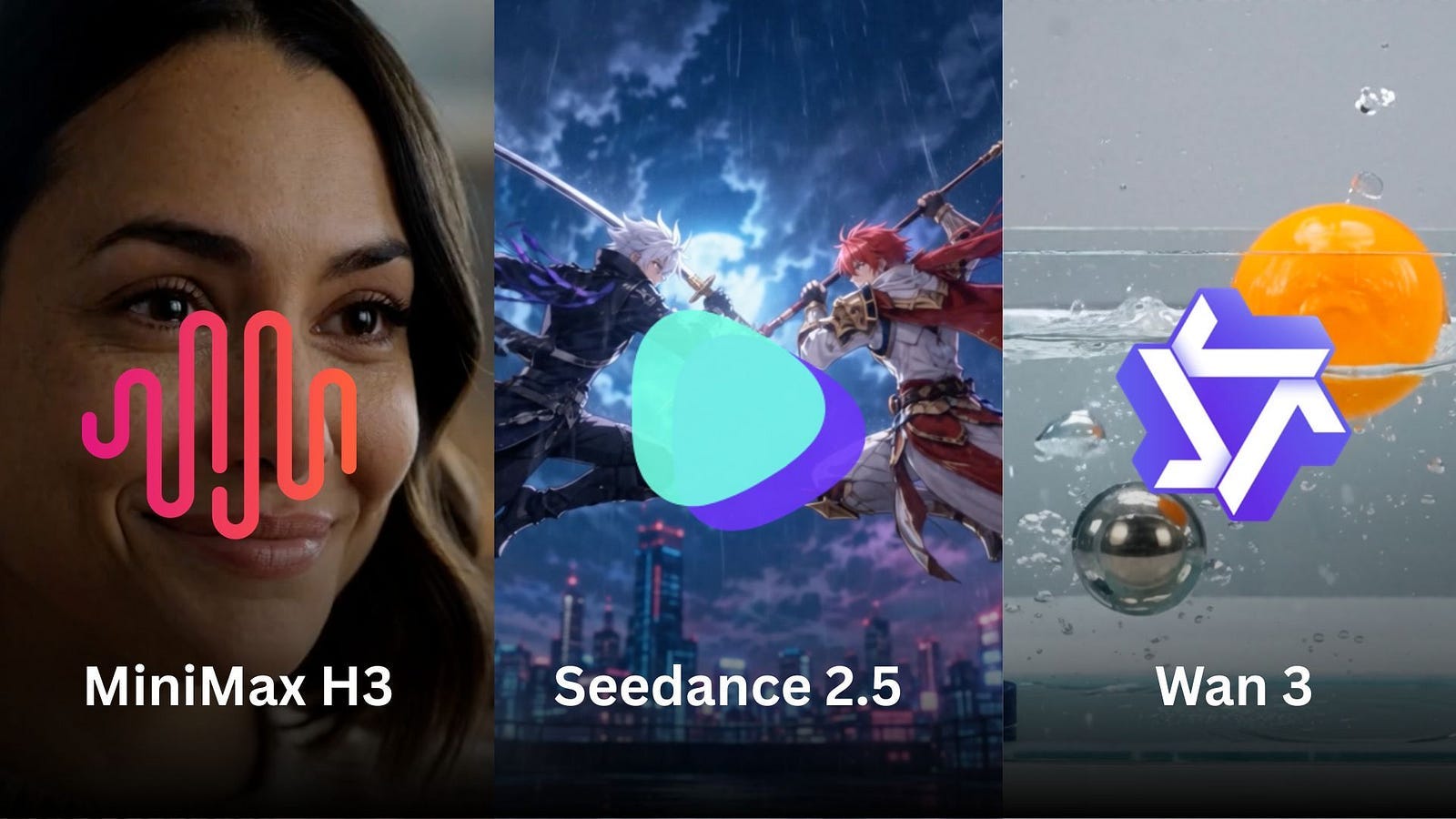
To see how three of the latest models compare, I tested Seedance 2.5, MiniMax H3, and Wan 3 using the same three prompts. The tests covered an action scene, a physics simulation, and a close-up emotional performance.
Creating the Videos With Topview
I used Topview’s AI video generator to create all the videos in this comparison. Topview lets you switch between different video models from the same workspace, so I could reuse a prompt, select another model, and generate the next video without moving to a different platform.

It was straightforward to use, and it supports many of the most popular video models available right now. You can access Seedance 2.5, Wan 3, and MiniMax H3 directly through Topview.
Here’s a quick comparison table:

How I Tested the Three Models
I used three prompts that required different skills from the models.
The first involved two characters fighting in the rain.
The second tested how two balls with different weights behaved in water.
The final prompt focused on small changes in a person’s facial expression.
For each test, I compared how closely the videos followed the prompt. I also looked at movement, physical accuracy, camera work, object consistency, facial expressions, and sound.
AI video generation can produce a different result each time, so your experience may not be exactly the same as mine. These are my observations based on the videos I created for this comparison.
Test 1: An Anime Fight Scene
Prompt: Create an anime-style fight on a rain-soaked rooftop at night. In one continuous shot, show a white-haired swordsman dodging a red-haired warrior’s spear, counterattacking, and ending in a blocked strike that creates a shockwave through the rain. Keep the choreography readable, the characters consistent, and every attack physically connected without teleportation, duplicated weapons, or distorted limbs.
This prompt required the models to manage two characters, two weapons, rain effects, and a moving camera at the same time. I also wanted the attacks to connect properly instead of having the characters jump between unrelated poses.
Seedance 2.5
What can I say? Seedance 2.5 was my favorite in this round. Its biggest advantage was the amount of camera movement it added to the scene.
The camera moved around the two characters, changed between different zoom levels, and completed an almost 360-degree turn. The model also slowed down a few moments during the fight, which made the attacks look more dramatic.
My only complaint is that the video didn’t include enough fighting. A large part of the 15-second clip was spent showing the characters and building up the scene, so I wanted more attacks and counterattacks before the ending.
MiniMax H3
My initial impression to the video was… meh. The MiniMax H3 video took a few seconds before the action started. Once the characters began fighting, their movements were slower than I expected, especially for an anime scene.
The camera also moved less than it did in the Seedance and Wan videos. This made the scene look quite plain compared with the other two results.
The weapons were also inconsistent. They disappeared during parts of the fight and then appeared again, even though the prompt specifically asked the models to avoid duplicated or disappearing weapons.
Wan 3
Wan 3 gave the characters faster and more dynamic movements than MiniMax H3. I liked how the water reacted whenever their feet touched the rooftop because the splashes matched their movements quite well.
The last few frames were especially good. Wan 3 added slow motion and dramatic music to the final attack, and both choices worked well with the scene.
Wan 3 had an impressive ending, but I preferred the camera movement Seedance 2.5 used across the whole video. That gave Seedance a slight advantage in this round.
Winner: Seedance 2.5
Test 2: Gravity and Water Physics
Prompt: Create a slow-motion shot of a steel ball and an orange table-tennis ball falling into a clear tank of water at the same time. The steel ball should sink while the table-tennis ball briefly submerges, rises, and bobs on the surface. Show realistic splashes, bubbles, ripples, reflections, refraction, gravity, and buoyancy using a locked side-view camera and one continuous shot.
The goal of this test was to see whether the models understood how objects with different weights and densities should behave in water. I also checked the splashes, bubbles, and sound effects around the tank.
Seedance 2.5
The orange ball reached the bottom of the tank before the much heavier steel ball, which looked weird and wrong. I also don’t think the table-tennis ball should have travelled all the way to the bottom before returning to the surface.
The water and reflections looked fine, but the movement of the two balls didn’t match their weight and buoyancy. This was the weakest Seedance 2.5 result from the three tests.
MiniMax H3
MiniMax H3 handled the physics much better. The steel ball sank while the table-tennis ball returned to the surface and bobbed on the water.
The splashes also looked realistic. Some water even spilled over the side of the tank, which added a small amount of messiness that you would expect from a real experiment.
Both balls behaved much closer to the way I expected, and I didn’t notice a major problem with the water physics.
Wan 3
Wan 3 made the orange table-tennis ball much too large. It looked closer to the size of a small beach ball, so the model clearly misunderstood that part of the prompt.
The way the balls moved through the water was still quite good, and the splashes looked realistic. The sound effects could have been better because there was no clear metallic clink when the steel ball hit the tank or a noticeable “bloop” when the balls entered the water.
Wan 3 did a decent job with the movement, but MiniMax H3 produced the most accurate result.
Winner: MiniMax H3
Test 3: A Subtle Emotional Performance
Prompt: Create a photorealistic close-up of a woman receiving upsetting news. Her faint smile slowly fades, her eyes become wet, and one tear rolls naturally down her cheek as she tries to remain composed. Show the emotional change through subtle eye movement, blinking, breathing, and facial tension while keeping her appearance and lighting consistent, with no dialogue, exaggerated crying, or face morphing.
This test focused on small facial movements rather than a large physical action. I observed that a lot of users are using AI to create short drama videos, so I wanted the woman’s expression to change slowly, without exaggerated crying or any obvious changes to her face.
Seedance 2.5
Can I say that this performance could win a best actress award? I loved how she continued smiling while trying to hold back her tears.
You could slowly see her expression change through her eyes, breathing, and facial tension. She eventually sighed, and that was when the tear started flowing down her cheek.
The movement of the tear also looked realistic. It changed as it moved instead of staying in the same shape or looking like it had been placed on top of her face.
MiniMax H3
MiniMax H3 did a good job with the deep breathing. It looked like she was trying to remain calm while holding back her tears, which matched the prompt.
Her tears finally started flowing during the last few seconds. The problem was that they moved too slowly and barely changed in shape or size as they travelled down her cheeks.
The facial performance worked, but the tears didn’t look as realistic as the ones in the other two videos.
Wan 3
Wan 3 also did a great job with this prompt. The ominous sound in the background matched the mood of the scene without making it too dramatic.
The tears fell naturally, and their movement looked physically accurate. I also liked the way she sighed at the end because it showed how upset she was without using dialogue.
Seedance 2.5 gave me the better overall facial performance, while Wan 3 did slightly better with the tears and sound. Both videos handled the prompt well, so I’m calling this round a tie.
Winner: Tie. Wan 3 and Seedance 2.5
Which Model Is the Best?
Based on these three tests, Seedance 2.5 is my overall winner.
It won the anime fight test, tied with Wan 3 in the emotional test, and produced the clips I found the most interesting to watch.
Camera movement was its biggest advantage. The other models could create good-looking scenes, but Seedance was better at moving around the characters and choosing when to zoom in or slow down.
Its weak point was the physics test. The movement of the two balls didn’t make sense, so I wouldn’t automatically choose Seedance for a video that depends on accurate physical behavior.
MiniMax H3 is the model I would use for a physics simulation or a product demonstration where the movement of objects matters. Its anime fight was slow, however, and the disappearing weapons were difficult to ignore.
Wan 3 was more consistent across the three tests. Its character movement, water effects, tears, and sound were all good, although it didn’t clearly beat both competitors in any single category.
For cinematic videos and emotional scenes, I would choose Seedance 2.5. For realistic physics, I would use MiniMax H3. If I wanted a balanced model with good movement and sound, I would consider Wan 3.
Final Thoughts
Alright, I hope you enjoyed this comparison article.
Overall, Seedance 2.5 gave me the best overall results from these three tests. I enjoyed its camera movement, and its emotional video had the most convincing performance of the nine clips I generated.
MiniMax H3 was much better at physics, while Wan 3 stayed competitive in both the action and emotional tests. Their results show how much the choice of model depends on what you’re asking it to create.
I recommend running your actual prompt through more than one model when you can. The best model for an anime fight may produce the wrong result for a simple water simulation, even when both prompts are detailed.
For the kinds of videos I normally create, Seedance 2.5 would be my first choice. Wan 3 would be a close second, while I would keep MiniMax H3 in mind whenever physical accuracy matters more than dramatic camera work.
What do you think of these video models? Any personal preference that’s not the same with mine? Let me know your thoughts in the comments.
Hi there! Thanks for making it to the end of this post! If you enjoyed this content and would like to support my work, consider becoming a paid subscriber. Your support means a lot!


