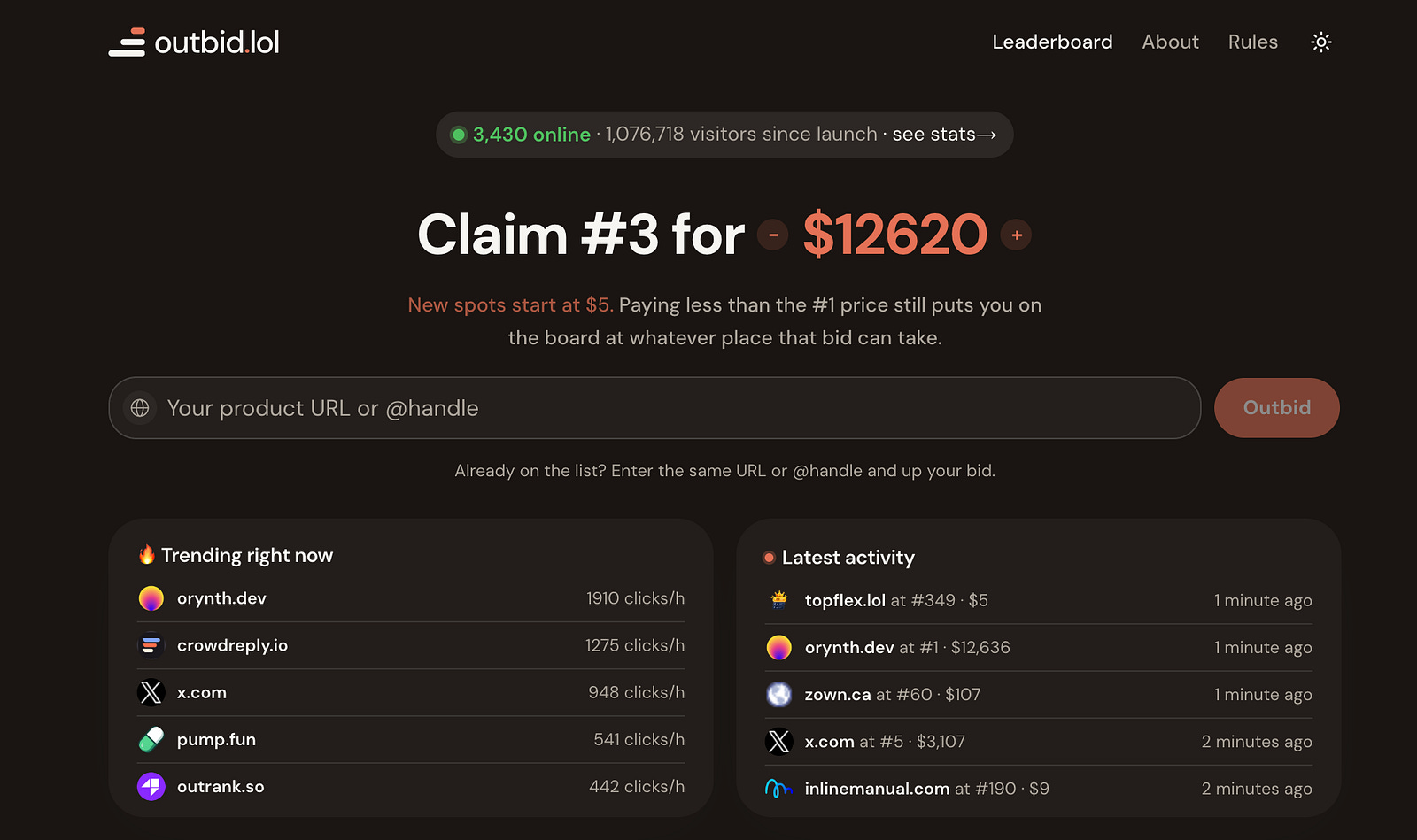
Over the past few days, my social media feed has been flooded with posts about Jonathan Wilke and a small project he built called Outbid.lol.
The concept is almost absurdly simple. You submit your app, product, website, or profile to a public leaderboard and pay to move higher. If somebody pays more than you, they take your position. If you want the top spot, you have to outbid whoever currently owns it.
Jonathan shared the project on X, and it quickly escaped the usual indie-hacker bubble. I started seeing screenshots of the leaderboard, revenue updates, people discussing whether the idea was brilliant or ridiculous, and of course other developers already thinking about variations of it.
A slew of similar websites immediately followed.
https://claimrank.lol
http://watchbid.lol
http://takeone.lol
http://lastspot.lol
http://overbid.lol
http://outrank.lol
http://spots.lol
http://bidwall.lol
http://rankly.vip
There will be more in the coming days… that’s for sure.
What caught my attention wasn’t that the underlying software looked technically difficult. It was the simplicity of the idea.
Outbid.lol Is Simple Enough to Explain in One Sentence
A lot of products I cover require several paragraphs before the business model becomes clear. Outbid doesn’t have that problem.
People pay for rank.
This guy just paid over $10,000
How crazy is that?
Someone can post a screenshot of the leaderboard on X and anyone looking at it understands what is happening almost immediately. There is no onboarding flow to explain and no feature list to study before the joke lands.
The public bidding also creates an interesting feedback loop. As more people visit the site, the higher positions become more visible. That makes those positions more desirable, which can encourage another bid.
Every unusually large bid then becomes something people can screenshot and share, bringing another wave of attention back to the site.
Jonathan shared some striking numbers during the launch. According to his updates, Outbid crossed 200,000 visitors in roughly its first day and generated tens of thousands of dollars in revenue. The site has since passed one million visitors, according to the counter displayed on Outbid itself.
As of today, Jonathan has made over $95K already. Tomorrow, that’s guaranteed to hit $100K.
Those are impressive numbers for any launch, especially for something that began as a relatively small web experiment.
But I don’t think the takeaway is simply that adding a payment button to a leaderboard prints money.
Virality Did a Lot of the Heavy Lifting
There is an obvious circular effect here.
People are willing to pay for a high position partly because Outbid has traffic. Outbid gets more traffic partly because people are talking about how much others are willing to pay for those positions.
That dynamic becomes much harder to reproduce if the initial attention never arrives.
A leaderboard with 50 visitors is very different from a leaderboard being watched by hundreds of thousands of people. The code can be identical while the economics are completely different.
There is also novelty involved. The first time I saw Outbid, I immediately understood why people were sharing it. The idea is slightly ridiculous, competitive, transparent, and easy to participate in.
Watching founders spend increasingly large amounts of money to move one row higher is part advertising marketplace and part internet spectacle.
That combination is difficult to engineer deliberately.
If twenty identical sites launched tomorrow, I doubt all twenty would experience the same result. Outbid benefited from being early enough for the concept to feel new, while Jonathan’s public updates gave people another reason to keep following the story.
Still, there are parts of the product design that are interesting beyond the viral moment.
The Leaderboard Is Also the Distribution Mechanism
Most software products separate the product from its marketing.
A developer builds an app, then needs another system for getting people to see it: SEO, ads, social media, newsletters, affiliates, or something else.
With Outbid, those two layers overlap.
People buying positions are effectively paying for exposure, but their purchases also change the product everyone else sees. A new highest bid modifies the leaderboard, creates competition, and potentially gives people something new to talk about.
That is probably the part I found most interesting as someone who builds web products myself.
The mechanic made me think less about copying the exact interface and more about what other versions of a paid ranking system could look like.
One limitation I noticed was that everything on Outbid essentially competes inside the same broad leaderboard. That is part of its charm because the randomness makes the site entertaining, but it also means completely unrelated products can end up competing for the same positions.
An AI tool could be sitting beside a design agency, developer product, newsletter, game, or personal profile.
I started wondering whether the same mechanic would feel different if the rankings were separated by category.
So I Built a Small Variation of the Idea
That thought eventually turned into ClaimRank.lol.

I want to be clear about where the idea came from because there isn’t much value in pretending otherwise. Outbid was the inspiration. I saw what Jonathan built, liked the underlying mechanic, and started thinking about one particular variation of it.
ClaimRank keeps the idea of paying to compete for positions, but organizes rankings into categories. Instead of every product fighting for one universal leaderboard, products can compete within a more relevant group.
That might make the ranking more useful, or it might remove some of the chaos that makes Outbid entertaining in the first place. I don’t know yet.
And that is really why I built it.
Not because I think categories somehow “fix” Outbid, or because every viral product needs a more feature-heavy competitor. Outbid is clearly doing something right as it is. I was simply curious about how the mechanic changes when the competition becomes narrower.
There Is a Bigger Lesson Here for Builders
One thing I have noticed from building software over the years is how easy it is to associate complexity with value.
It is tempting to believe a better product needs another dashboard, another AI integration, another automation workflow, or another dozen settings. Meanwhile, something like Outbid can appear with a mechanic that takes seconds to understand and suddenly dominate everyone’s feed.
That doesn’t mean simple products are easy to make successful. Distribution, timing, audience, novelty, and luck still play enormous roles.
But it does show that a product can be interesting because of the behavior it creates rather than the number of things it can do.
Outbid created competition around a number on a webpage. That competition created content. The content brought visitors. More visitors made the rankings more valuable, and the cycle continued.
Whether that momentum lasts is a separate question. Viral traffic can disappear as quickly as it arrives, and a launch-week revenue graph doesn’t tell us what the business will look like months from now.
For now, though, Outbid.lol is a fascinating example of how far a very small idea can travel when the product itself gives people a reason to keep talking about it.
It was interesting enough that I ended up building my own experiment around the concept.
Now I’m curious to see what happens to both.


