Seedance 2.5 vs Seedance 2.0: What's Changed?
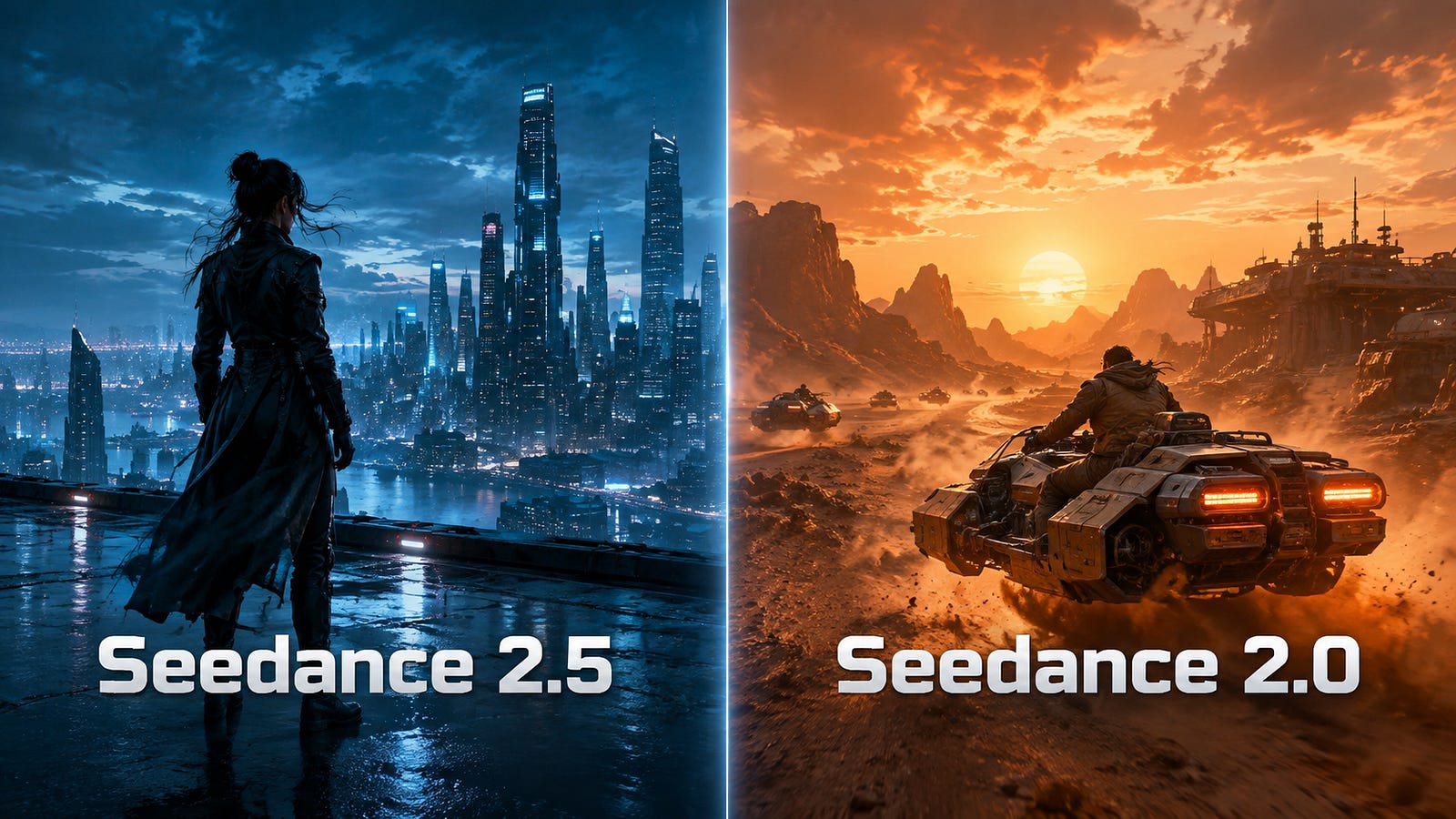
Seedance 2.5 offers huge improvements over Seedance 2.0. Check out our side-by-side comparison on Pollo AI.
Seedance 2.0 has dominated the AI video space over the past couple of weeks. Its realism quickly went viral, along with its ability to recreate famous people and copyrighted characters. That also made the model controversial, drawing criticism from Hollywood groups and actors’ unions over copyright and consent concerns.
Now, Seedance 2.5 has arrived on video-generation platforms like Pollo AI, and I was curious to see how it compares with Seedance 2.0.
For this post, I tested both models using the same four scenarios: an anime action sequence, a realistic battle, a water and gravity test, and a dramatic human performance.
I compared their motion, camera control, consistency, physics, facial expressions, and prompt adherence.
Both Seedance 2.5 and Seedance 2.0 are available from the model selector in Pollo AI, making it easy to run the same prompt through each one.
Before we get into the actual video comparison, let’s see how the features compare.
Seedance 2.5 vs Seedance 2.0 Feature Comparison
The biggest changes in Seedance 2.5 are longer videos, more reference inputs, and better editing controls. Here is how the two models compare.
The jump from 15 to 30 seconds is the biggest upgrade for me. Seedance 2.5 can fit more action, dialogue, and narrative progression into a single generation without stitching several clips together.
Its reference limit is also much higher, which should help with projects involving multiple characters, products, locations, or motion references.
The quality difference is less straightforward. ByteDance says Seedance 2.5 improves image, audio, and motion quality, while Pollo AI advertises native 4K output.
However, my tests showed that Seedance 2.0 can still produce better results in certain scenes, particularly anime action and emotional performances. Seedance 2.5 has more features, but it is not automatically better for every prompt.
Alright, now let’s do a side-by-side comparison now.
Prompt #1: Anime action sequence
A cinematic anime swordswoman sprints across a neon-lit rooftop in the rain and clashes with a masked opponent. The camera tracks beside her, circles both fighters during three rapid strikes, then follows as she slides under an attack and returns to her feet. Maintain consistent characters, readable choreography, smooth camera movement, and realistic rain and reflections.
I chose an anime action sequence to test how well each model handles stylized movement without losing visual consistency. The scene combines running, sword fighting, rain, reflections, energy effects, and a moving camera, giving the models several details to manage at once.
Fast anime choreography can easily become blurry or disconnected, especially when characters cross paths or the camera changes position.
I expect this test to reveal differences in character stability, body movement, shot composition, and whether the action remains easy to follow.
Here are the results:
Seedance 2.5
This result looks fantastic. The neon lights reflecting on the wet rooftop add depth to the scene, while the camera shake makes the character’s sprint feel fast and intense. I also liked the brief slow-motion moment as she slid across the ground.
The movement feels smooth and cinematic, but I wish the scene included more actual fighting. Most of the clip builds toward the confrontation rather than showing it.
Seedance 2.0
I was more surprised by this result. It looks closer to a finished anime sequence, with more action and a stronger sense of choreography. The camera movement is also excellent and manages to keep up with the fight without making it difficult to follow.
Winner: Seedance 2.0
Prompt #2: Realistic battle scene
A soldier runs through a war-damaged city as an armored vehicle speeds behind him. The handheld camera follows closely while an explosion sends dust, concrete, and glass across the street, forcing him to duck behind an overturned car. Show realistic movement, debris physics, vehicle weight, motion blur, and spatial continuity with no cuts or graphic injuries.
The realistic battle scene raises the difficulty by combining human movement, a fast vehicle, an explosion, and flying debris within one continuous shot.
I want to see whether the models can maintain a believable sense of space while several objects move at different speeds. Details such as the soldier taking cover, the vehicle turning, and debris reacting to the explosion should expose weaknesses in motion and physical interaction.
This test should make improvements in camera control, environmental consistency, motion blur, and high-speed rendering more noticeable.
Here are the results:
Seedance 2.5
The action looks very convincing here. The explosion, debris, and collapsing building have a real sense of scale and weight. I especially liked how the destruction continued behind the soldier instead of appearing as a brief effect.
It did miss one clear instruction: the car he ducks behind is not overturned. That is a noticeable prompt-adherence issue, even though the scene itself looks realistic.
Seedance 2.0
The camera work is the strongest part of this result. It follows the soldier closely, and the handheld shake adds intensity without making the action unreadable. The explosion, smoke, and dust also look convincing.
The main problem happens when the car enters the scene and hits the armored vehicle. The transition looks unnatural, and the vehicle seems to disappear during the collision. That breaks the spatial continuity the prompt was designed to test.
Verdict: Both models missed some details, which suggests that long action prompts are still difficult to follow precisely. Seedance 2.5 produced the more convincing scene overall.
Prompt #3: Water and gravity test
A glass pitcher falls from a kitchen counter and releases water toward a rubber ball, metal spoon, and folded cloth. The spoon falls and rotates, the ball bounces onto the floor, the cloth absorbs water, and the remaining liquid pours over the edge into a spreading puddle. Show realistic gravity, collisions, splashes, reflections, refraction, and object consistency.
For the physics test, I included water and several objects with different weights and materials. The spoon should fall and rotate, the ball should bounce and roll, the cloth should absorb water, and the liquid should flow naturally over the counter.
Video models often produce attractive water effects while getting the underlying physics wrong, so this scene gives me several specific interactions to examine. Any difference in gravity, collisions, fluid motion, reflections, or object permanence should be visible without relying too much on personal taste.
Here are the results:
Seedance 2.5
The pitcher tipping over on its own looks unnatural, and water appears on the cloth before the main stream reaches it. Those details make the beginning of the clip feel artificial.
Once the water starts moving, though, the result becomes much more convincing. The splashes have weight, and the way the water pushes the spoon looks surprisingly realistic. The interaction between the liquid and the objects is the best part of the clip.
Seedance 2.0
The water reacts too late after the pitcher falls, so the physics already look wrong within the first few seconds. The pitcher and liquid seem disconnected rather than part of the same event.
The rest of the video is much better. The objects respond to the water, and the cloth appears to absorb it instead of behaving like a solid surface. Even so, the delayed water movement is too noticeable to ignore.
Winner: Seedance 2.5.
Prompt #4: Dramatic human scene
A woman reads a handwritten letter alone at a kitchen table late at night. Her guarded expression gradually shifts to disbelief, her eyes fill with tears, and she looks toward an empty chair with a small smile before lowering her gaze. Show restrained facial acting, natural blinking and breathing, accurate eye focus, stable identity, and a gentle camera push-in.
The final prompt slows down the action and focuses on a subtle human performance. A convincing emotional shift requires more than a sad facial expression.
The model needs to manage eye focus, blinking, breathing, facial muscles, tears, and small changes in posture while keeping the person’s identity stable. I included a letter and an empty chair to give the character clear emotional cues without using dialogue.
This should reveal whether the newer model can create a more natural performance and maintain emotional continuity throughout the shot.
For this test, I wanted to see how both models handle a starting frame. So I fed both of them with this image:
Here are the results:
Seedance 2.5
The performance is restrained but still communicates a lot. I particularly liked the moment when she looks up and gives a small smile. It makes you wonder what she read without spelling out the emotion.
Her expression remains natural, and the model keeps her face stable throughout the scene. It feels like a quiet acting performance rather than a sequence of exaggerated expressions.
Seedance 2.0
Seedance 2.0 also handles the performance well. The slow camera push draws attention to her face, while the tears and subtle expression create a stronger sense of heartbreak.
Even without dialogue, the scene gives you a clear impression of what the letter might contain. Seedance 2.5 is more restrained, but I found the Seedance 2.0 result more emotionally affecting.
Winner: Seedance 2.0
Which Model Should You Choose?
My results ended in a tie, with each model winning two tests. The better choice depends on the type of video you want to create.
Seedance 2.5 performed better in the realistic battle and physics tests. I would choose it for scenes involving explosions, debris, water, environmental destruction, or several objects interacting at once. Its output often had a stronger sense of weight, although it still missed some prompt details.
Seedance 2.0 won the anime and dramatic performance tests. It produced more complete action in the anime scene and created the more emotionally affecting human performance. For stylized animation, close-ups, or scenes driven by facial expressions, Seedance 2.0 remains a strong option.
Neither model followed every instruction perfectly. If your prompt contains several actions, objects, and camera directions, expect some details to be ignored or changed. Shorter prompts and additional generations may still be necessary.
Final Thoughts
I expected Seedance 2.5 to win most of these tests, but the results were much closer than that. It produced more convincing physics and realistic destruction, yet Seedance 2.0 still did better with anime action and human emotion.
Seedance 2.5 feels like an improvement in specific areas rather than a complete replacement for Seedance 2.0. The newer model can handle complex physical scenes well, but that advantage does not carry across every style or type of movement.
For now, I would keep both models available and choose between them based on the scene. Seedance 2.5 is my pick for realism and environmental action, while Seedance 2.0 remains surprisingly competitive when style and emotion matter more.
What do you think? Let me know your thoughts in the comments.
Hi there! Thanks for making it to the end of this post! If you enjoyed this content and would like to support my work, consider becoming a paid subscriber. Your support means a lot!


